
Tuesdays in Advent, 2*

When I was a writing teacher, I let go of the idea that writing is a linear process that has four neat, distinct stages.
These linear stages move forward in a straight line, from planning, to drafting, revising, and then editing.
In this model, as writers move to each new stage, they leave the others behind.
However, I’ve never actually written anything in this neat series of stages. What really happens when I write is that as I finish writing a draft (stage two) and then revise it (stage three), I will discover that I need to go back to the beginning again and do more planning. Though I move on from stage one to stage two and then to three, I can still circle back to stage one. In fact, this circling back usually happens more than once.
Such a series of moves suggests that the steps of my process are not neat and linear, progressive and orderly. They are recursive and circular.
I once drew a picture of my writing process for a class. Here it is:
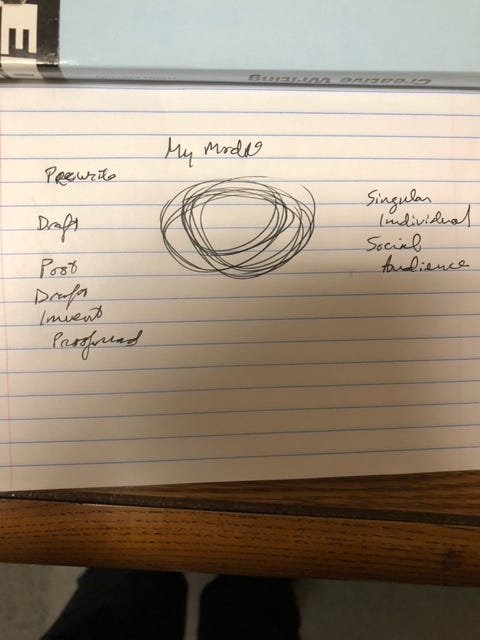
It looks more like a dust storm, or perhaps a double exposure of a doughnut, than it does a writing process. But this is what it looks like to have my writing process and to be recursive.
Recursiveness also informs how I think about grief. When I hear people say that they think that their friend who lost someone eight months ago should now be ‘getting over it” or “moving on,” I hear them espousing a linear view of grief. And, of course, some rare people do “get over it” quickly, or seem to. But I suspect that this isn’t the norm.
For me, even three years after we lost our son, it could seem that for days I was doing well, and then a random statement from someone about how they helped their aunt to find the right level of medication and now she’s fine would trigger a memory of how we didn’t find the right medication for Michael, and I’d be back in deep sadness.
After our second year after our loss, I was surprised that I was feeling heavy and depressed as Michael’s second non-birthday came around. I was surprised because the previous year, for the first non-birthday, I’d been okay.
One Survivors of Suicide group facilitator helped me with this. She compared grief to being on a carousel, one in which we pass through a holiday or a significant day at one height, and the next time we pass through it, we do so at a lower level. We return to holidays where we previously thought we were doing okay, but now we are down where a year earlier we were up. We return to the beginning or to earlier steps over and over again.
This happens because our lives move through a yearly calendar that brings around again a new cycle of birthdays, holidays, seasons, anniversaries, and special events. It is entirely reasonable to experience an anniversary pleasantly one year, and then the following year to experience grief and sadness. It is possible for this sadness to happen years after a loss.
Thinking about grief as recursive rather than linear and as an up and down ride on a carousel has helped me to accept the long journey that grief is. It has helped me to accept that grief is messy. Every year, starting in early October with the day we lost Michael, I brace myself and try to cope to get through a long holiday season.
Ann Hood notes in her grief memoir Comfort that even six years after losing her five-year old daughter to a fatal disease, the strange movements of grief could continue:
Grief is not linear. People kept telling me that once this happened or that passed, everything would be better. Some people gave me one year to grieve. They saw grief as a straight line, with a beginning, middle, and end. But it is not linear. It is disjointed. One day you are acting almost like a normal person. You maybe even manage to take a shower. Your clothes match. You think the autumn leaves look pretty, or enjoy the sound of snow crunching under your feet.
Then a song, a glimpse of something, or maybe even nothing sends you back into the hole of grief. It is not one step forward, two steps back. It is a jumble. It is hours that are all right, and weeks that aren’t. Or it is good days and bad days. Or it is the weight of sadness making you look different to others and nothing helps. Not haircuts or manicures or the Atkins Diet. (52, 53)
I think Ann Hood really nails it here. Grief is not all one mood, a cloud that covers us for six months and then vanishes and we have all sunshine again forever. No one feels this. We shouldn’t expect those around us who are grieving to feel this way.
We talk about grief mainly in terms of losing loved ones. They die and we never see them again. But there are also people during this holiday season who are grieving the loss of a job, the loss of a marriage they valued, the loss of community to economic conditions, the loss of friends they have valued. These losses are significant. During the holidays, they can be devastating.
This second week of Advent is devoted to peace. I think of peace in terms of having it with other people—in terms of community—and in terms of the peace that God offers us. As with hope, I have begun to think that it is important to put peace in our plane of vision, even when we are far from it. Perhaps especially when we feel far from it. This affirmation is something that is done in the Jewish practice of Sitting Shiva. Especially during the shiva, what are the first seven days of mourning, the people who support the mourners are mostly silent and listening, but they include hope in the community prayers before they leave the mourner’s home.
Of course, if you are grieving, hope can seem out of reach. Even after two years, we can carry on and do pretty well most days, but we don’t know when we are going to be hit again with a blast from the past.
When we are meeting during the holiday season, I find it helpful to simply consider that most of the people around me might be dealing with aspects of their past, or they might be worried about their health or their job. Peace might be desirable but unattainable right now. If I am interested in doing the things that make for peace, I’ve found that listening to others is perhaps a good place to start. Of course, I don’t listen very often. I spend a lot of my time wanting to get my own points across. The holidays seem like a time when I could start to look at people as though they are potential friends, see them in terms of peace, see them as people who might tell me a good joke or something I haven’t heard before.
Most of the time I’m not like this, and so I miss out on most of these real possibilities. And most of the time, I do have relapses of grief.
Certainly, after eight years now, my grief has changed. It hasn’t gone away. It never does. But it has changed. I expect to find myself during this holiday season experiencing a range of emotions and possibilities. I have had moments when I’m back eight years ago right after Michael took his life. Over the last few days, I have also felt real peace just watching the sun going down behind trees stripped of their leaves.
I look forward to seeing family at Christmas. But I know that in the middle of the gathering, I may step outside to be alone for a while just to listen to the silence. This is my attempt to allow the process to go full circle. Maybe eventually we will arrive at peace.
Work Cited
Hood, Ann. Comfort: A Journey Through Grief. New York: W.W. Norton, 2008.
*Friends, this month, during Advent, I’m posting a little more than just the third Tuesday, mainly on grief and the holidays. I hope you will join me in this.

Tom, as I think about hope, peace, joy, and love this Advent, I think that they must be aspirational. Although you don't use that word in this post, at least not that I saw, it seems that your writing about Advent is full of the idea. Yes, peace has come in the Savior, but it seems to have barely got in the door sometimes. Other times, there is peace. But, sad to say, more often than not, the peace we experience is partial and temporary. This is as it should be, I think, for it makes us long for it all the more, and this longing is what Advent is about for me this year. Forgive me if I'm superimposing my response onto your writing, but it seems that we are both longing, hoping against hope even, that one day the peace that is partial will be pervasive and permanent. Keep writing, friend.
Again, Tom, you have shared many wise observations about writing and life. After all, one is a reflection of the other. This part is my favorite: "The holidays seem like a time when I could start to look at people as though they are potential friends, see them in terms of peace, see them as people who might tell me a good joke or something I haven’t heard before."
May God bring you peace, even in bits and pieces, and may those "potential friends" become a reality.